SlicerSOFA
Real-time soft-tissue simulation inside 3D Slicer, built on the SOFA framework, and made to work through SlicerROS2 so a simulated organ can meet robotic and haptic hardware on a research bench.
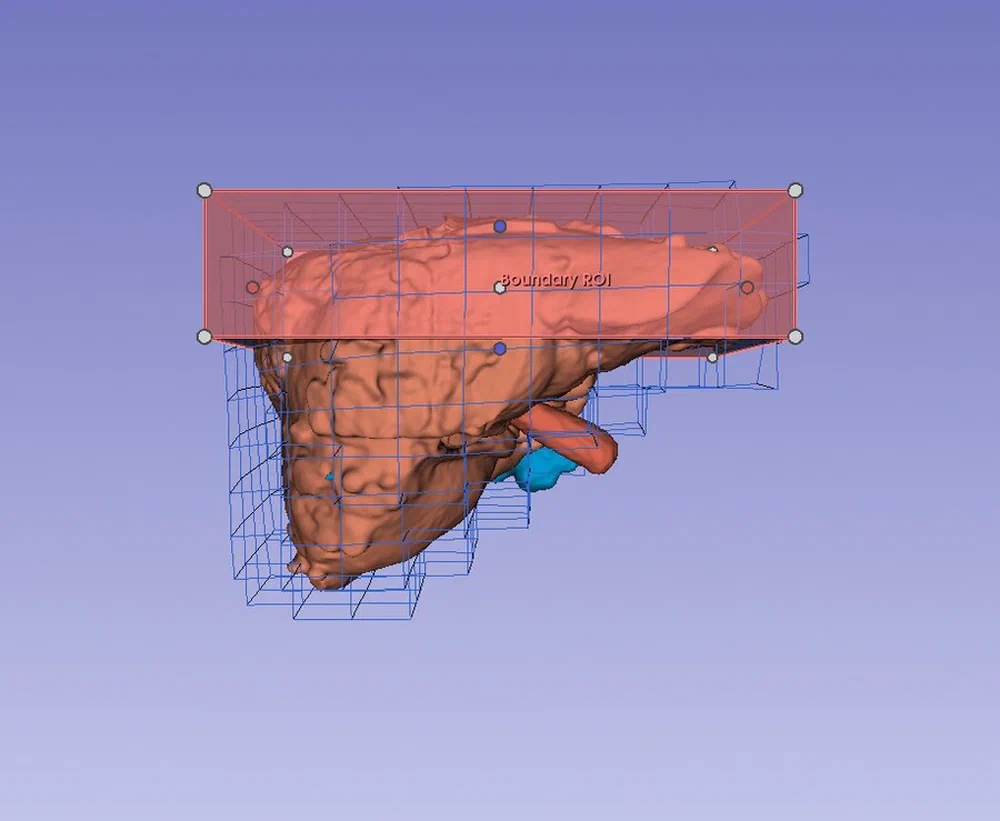
Planning software that treats anatomy as rigid stops being useful the moment a surgeon touches it. SlicerSOFA closes that gap by bringing SOFA — a framework for real-time, interactive biomechanical simulation — into 3D Slicer, so segmented anatomy in a Slicer scene can deform, be probed, and respond to forces rather than sitting still.
It lives in the upstream Slicer organisation rather than ours: simulation
belongs to the platform, not to one lab. Development is done with Inria, the
group behind SOFA itself.
Components
The simulation core wires SOFA’s solvers to Slicer’s scene: a segmented organ becomes a simulable mesh, with the grid, material parameters and boundary conditions expressed as scene nodes so a simulation is set up the way the rest of a Slicer workflow is.
Interoperability with SlicerROS2 is what lets the simulation meet hardware. The Slicer ↔ ROS 2 bridge itself is SlicerROS2, which we do not maintain; our part is making a SOFA simulation work through it, so a robot or a haptic device can be driven against the deforming model on a research bench.
The robotic and haptic demonstrations live in slicer-ros2-demos and sofa-ros-haptic-demo, all reproducible from a SystoleOS manifest.